


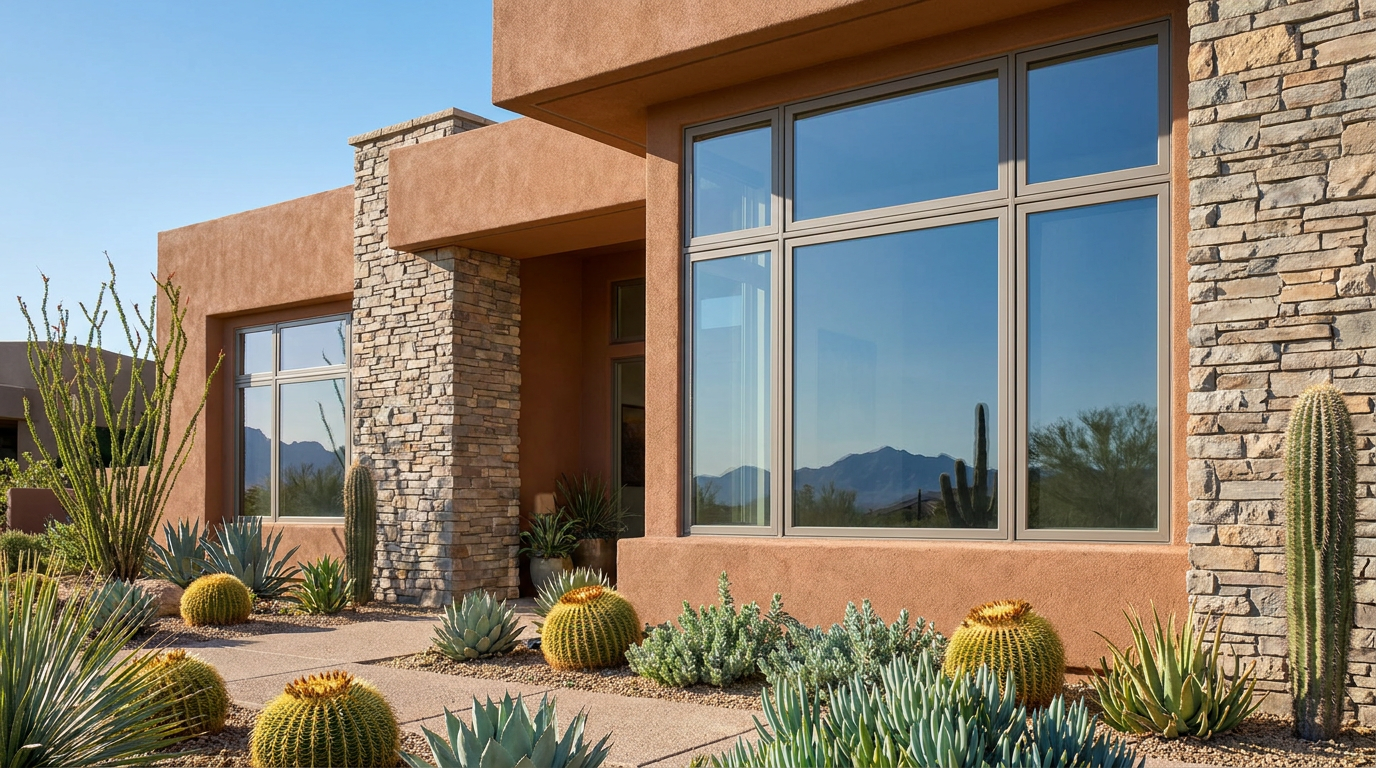
Choosing replacement windows in Arizona isn’t just about aesthetics. It’s an investment in your home’s defense against brutal summer heat, intense UV radiation, and high energy bills. With options ranging from vinyl and fiberglass to aluminum and wood, making the right choice can feel overwhelming. We manufacture windows here in Phoenix, and this guide provides the clarity you need to make the right decision for your home.
Table of contents:
- The Short Answer: Which Window Material is Best for Arizona?
- Window Material Comparison for Arizona Homes
- A Deeper Look: Energy Shield Sunshield® Vinyl
- The Truth About The Negatives of Vinyl Windows
- Alternative Material Analysis: Fiberglass, Aluminum & Wood
- What Is the Cheapest Time of Year to Replace Windows?
- Frequently Asked Questions
The Short Answer: Which Window Material is Best for Arizona?
For the vast majority of Arizona homeowners, our factory-direct Sunshield® Vinyl windows offer the undisputed best combination of energy efficiency, long-term durability, and value. While other materials have their place, they often entail significant trade-offs in cost, maintenance, or thermal performance, making them less suitable for our extreme climate. Sunshield® Vinyl is specifically engineered in Phoenix to withstand intense UV exposure and heat without warping, cracking, or fading.
The Bottom Line: If you want to dramatically reduce your cooling costs, eliminate maintenance, and get a product proven to last in the desert sun, our custom-built Sunshield® Vinyl is the smartest investment for your home.
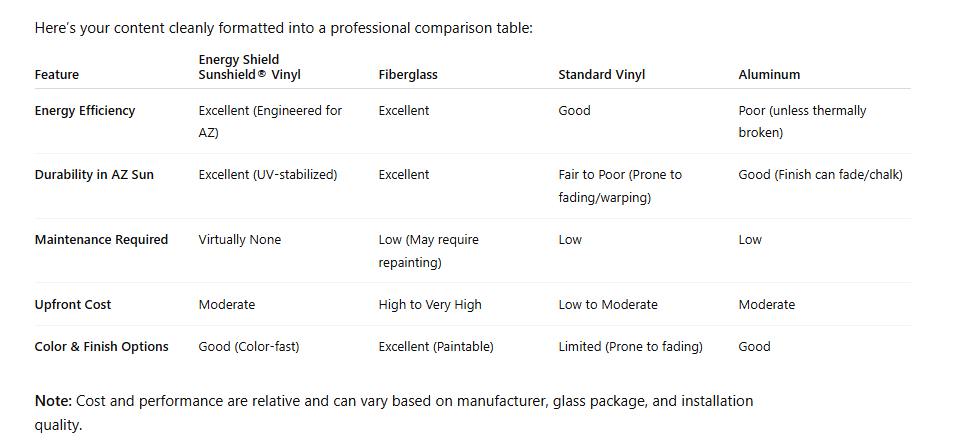
Window Material Comparison for Arizona Homes
The wrong window material can turn into a costly mistake, leading to higher energy bills and premature failure. This table breaks down the key differences based on what matters most to Arizona property owners. We've separated our specialized Sunshield® Vinyl from generic vinyl to highlight the critical distinctions.
A Deeper Look: Energy Shield Sunshield® Vinyl
Not all vinyl windows are created equal, a fact that becomes painfully obvious under the Arizona sun. We developed Sunshield® Vinyl because standard, off-the-shelf vinyl formulas used in milder climates simply fail here. As a local Phoenix manufacturer, we have spent over 25 years perfecting a uPVC (unplasticized polyvinyl chloride) blend that contains high concentrations of titanium dioxide and other stabilizers to reflect solar radiation and resist thermal degradation.
This means our frames won't yellow, warp, or become brittle over time like lower-quality vinyl. By extruding and building your windows right here in our Phoenix factory, we control every aspect of production. This factory-direct model eliminates middlemen, cuts down lead times, and ensures your windows are built by Arizonans, for Arizona homes. The result is superior performance that directly translates into lower energy bills and enhanced home comfort.
Ready to see how affordable factory-direct quality can be? Get your free, no-obligation estimate today.
The Truth About The Negatives of Vinyl Windows
Many homeowners rightfully ask about the downsides of vinyl. The negative reputation comes almost exclusively from low-quality, builder-grade products. These are often made with recycled vinyl and insufficient UV inhibitors, leading to the problems people fear: warping in the heat, chalky fading from the sun, and seals that fail within a few years. They can have a thicker, less elegant profile, reducing your glass-to-frame ratio.
Here’s the part most companies won’t tell you: those are valid concerns for the wrong vinyl. Our Sunshield® Vinyl was engineered specifically to solve these issues.
- Warping and Fading: Our proprietary uPVC formula is guaranteed to withstand Arizona's climate without losing its shape or color integrity.
- Seal Failure: We use advanced warm-edge spacer technology and state-of-the-art glass packages that are rated for extreme temperature fluctuations, protecting the argon gas fill and ensuring long-term efficiency.
- Appearance: Modern extrusion technology allows us to create stronger, sleeker frames that maximize your view and natural light, rivaling the look of more expensive materials.
Essentially, we took every known weakness of vinyl and engineered a solution for it. That's the Energy Shield difference and why we're ranked #1 in Arizona for window replacement.
Alternative Material Analysis: Fiberglass, Aluminum & Wood
Fiberglass Windows
Fiberglass is an incredibly strong and durable material, composed of glass fibers and resin. It expands and contracts very little with temperature changes, making it stable in our hot climate. Its primary benefit is that it can be painted, offering more custom color options for homeowners pursuing a specific design vision. However, this strength comes at a significant cost premium, often 50-75% more expensive than our high-performance vinyl without offering a major leap in energy efficiency.
Verdict for Arizona: A great, but very expensive, option. For most homeowners, the substantial extra cost doesn't deliver a proportional return on investment compared to Sunshield® Vinyl. It's best reserved for historic renovations or homes where a specific paintable color is a non-negotiable design requirement.
Aluminum Windows
Aluminum frames are strong, lightweight, and allow for very thin profiles, which many people find aesthetically pleasing for a modern look. While durable, standard aluminum is a natural conductor of heat. In Arizona, this means the frame itself gets hot and transfers that heat directly into your home, forcing your AC to work harder. While "thermally broken" aluminum windows with an insulating barrier exist, they are more expensive and often still don't match the thermal performance of high-quality vinyl.
Verdict for Arizona: Generally not recommended for residential applications unless you opt for a high-end thermally broken product. For most homes, the energy penalty of standard aluminum is too great a price to pay for its slim profile.
Wood Windows
Wood offers a timeless, beautiful aesthetic that no other material can perfectly replicate. However, in Arizona's dry, hot climate, wood is a high-maintenance nightmare. It is highly susceptible to rot, insect damage, and warping. It requires regular sanding, sealing, and painting to prevent cracking and deterioration under intense UV exposure. While beautiful, the constant upkeep makes it an impractical choice for all but the most dedicated homeowners.
Verdict for Arizona: Avoid unless you are committed to a rigorous annual maintenance schedule. The initial beauty is quickly overshadowed by the cost and labor required to keep it from failing in our climate.
Should I Replace 30-Year-Old Vinyl Windows?
Yes, absolutely. Window technology from 30 years ago is fundamentally obsolete compared to today's standards. Even if your old vinyl windows don't look broken, they are costing you significant money and comfort. The difference is like comparing a dial-up modem to high-speed fiber optic internet.
Here’s what has changed:
- Low-E Coatings: Early Low-E (low-emissivity) coatings were minimal. Today’s multi-layer coatings, like our Solar-E™ glass, are spectrally selective. They are precisely tuned to block heat-causing infrared and furniture-fading UV light while allowing visible light to pass through, keeping your home bright but cool.
- Gas Fills: Older double-pane windows often just had air between the panes. We fill our windows with dense, inert Argon gas, which provides a much more effective thermal barrier.
- Frame & Seal Technology: A 30-year-old vinyl frame has likely endured tens of thousands of hours of UV exposure, making it brittle. The seals have almost certainly lost their flexibility, leading to drafts and moisture intrusion. Our fusion-welded Sunshield® Vinyl frames and advanced spacer systems create a permanent, airtight unit that lasts for decades.
Replacing those old windows isn't just a repair. It's a major upgrade to your home's entire building envelope, and the energy savings often begin paying you back from the very first month. Many of our customers report a noticeable drop in their summer AC bills and a dramatic increase in comfort. Wondering how much vinyl replacement windows cost? We can provide a clear, detailed estimate.
What Is the Cheapest Time of Year to Replace Windows?
Some homeowners believe there's a "slow season" for window replacement, typically in late fall or early winter, that might yield a lower price. While demand can fluctuate, waiting for a hypothetical discount is often a costly strategy in Arizona. The real cost isn't just the price of the windows; it's the money you're wasting on energy with your old, inefficient ones.
Think about it this way: enduring another brutal summer with leaking windows can easily add hundreds of dollars to your cooling costs. That extra expense often completely negates any small seasonal discount you might have found. The smartest time to replace your windows is as soon as you realize they are failing. This stops the energy waste immediately and allows you to start enjoying a more comfortable home right away.
We understand that new windows are a significant investment. That’s why we offer flexible financing options to make the project manageable for your budget, any time of year. Don't let upfront cost prevent you from making a smart long-term investment in your home. Explore our special financing options and get started today.
Frequently Asked Questions
The Smart Choice for Arizona
While fiberglass offers strength and wood provides classic beauty, neither can match the optimized, climate-specific performance of Energy Shield's Sunshield® Vinyl for the price. It delivers exceptional energy efficiency, requires virtually no maintenance, and is guaranteed to withstand the harsh desert climate for decades. By manufacturing our windows locally in Phoenix, we provide factory-direct quality and value that other window companies simply cannot match.
Like one of our customers, Craig Richards, noted after extensive research, many homeowners choose Energy Shield because they "believe they offer the best product on the market." Don't settle for a one-size-fits-all solution. Invest in a window built for your home and your climate.